The idea
I made my dog the hero.
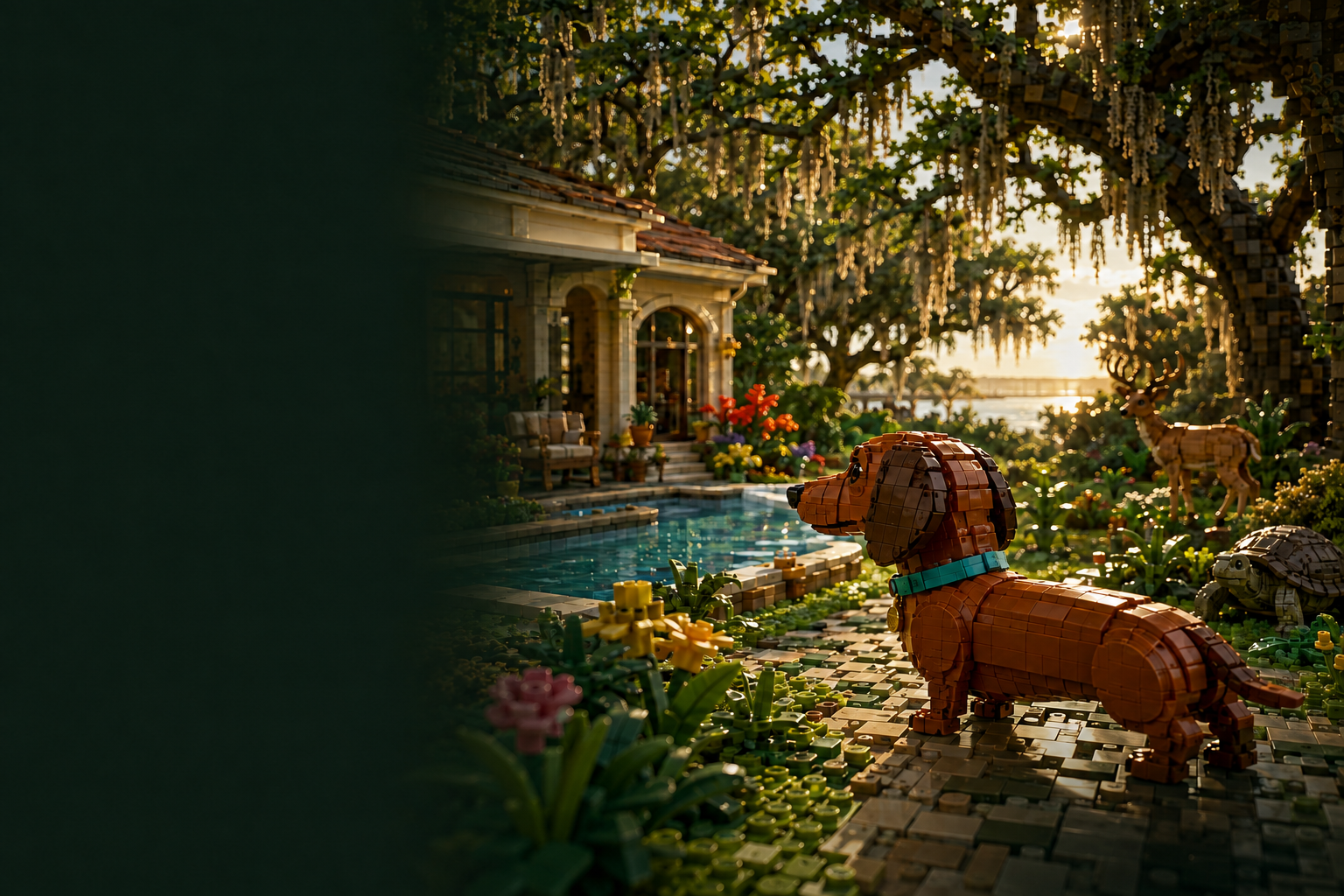
The game is for Meredith. The hero is Ruben, our red, short-haired miniature dachshund, who we call Boobs. I wanted it to feel like ours: our dogs, our people, the things we find funny, and a completely unreasonable adventure built around a very small animal.
It starts in a Florida backyard, with a lanai, a pool, and live oaks. Ruben sniffs around and discovers that something is wrong. From there, looking after the family turns into a dragon problem. He handles this with the equipment available to him: a nose, some digging, and considerable confidence in his own bork.
You follow clues, collect things, and build defenses. The absurdity is part of the point, but I still want the player to care about getting everybody home.
The game gives him dog problems and lets them become adventure problems. A smell leads somewhere. A suspicious patch needs digging. Something enormous probably needs barking at. That is a better starting point for Ruben than handing him a sword.
It didn’t stay in the backyard.
The first three chapters form the heart of the story: discover the dragon threat, strengthen home, then prepare to follow the clues beyond it. The prototype has since grown to thirteen chapters, with later journeys through a fictional music festival, New Orleans, Deep Ellum and a Dallas stadium, the Grand Canyon, a family reunion, and a mission to restore Meemaw’s peace, a Stingers helicopter adventure at Camp Pendleton, and a coastal journey to a concert at Shoreline.
The look is inspired by the playful feel of toy-brick adventures. The environments are original, compressed interpretations rather than measured maps. This is an independent personal project, with no affiliation to LEGO.
What is playable today includes a 3D world, scent trails, an evidence journal, building puzzles, listening activities, digging, earned gold, a persistent gear shop, sound controls, and browser saves. Later chapters also have their own entry points and save slots.
Try it yourself
See what Ruben is dealing with.
The separate game page gives you more room, especially on a phone. You can also open it below. No account or installation is needed.
The game loads only when you choose to play.
Controls and a quick digging tip
- Move: WASD or arrow keys; Shift to trot. Click a reachable spot to walk, or use “Walk the scent trail.” On touch devices, use the thumbstick.
- Explore: Q to sniff, R to listen, B to bork, F to dig, E to investigate, Space to build. Follow the highlighted action near an objective.
- Dig: F opens the puzzle. Read the named soil patch, then click or tap that same square twice. The first tap reveals a star and “Tap again”; the second uncovers the item.
- Pause and help: Escape opens the menu; J opens the journal. Sound and music controls are in the pause menu.
Progress stays in this browser on this site address; it does not sync between devices or domains. Desktop is the easiest starting point. Touch controls now keep the center clear: tap the compact objective strip for guidance, use the thumbstick and highlighted action, and find camera and sound settings in the menu.
Family update · September 13, 2026
The family made it into the game.
Malcolm and Meredith now have personal toy-like likenesses, and Scruffer joins Ruben on the journey. The thirteen-chapter prototype adds chapter training, visible uses for learned skills, earned moments of affection toward Meredith, Scruffer accessories, and 28-second animated chapter celebrations with five camera shots, character action and personal jokes. Existing gold and wardrobe purchases stay with the adventure.
The last two requested chapters are now playable. XII, I Need a Miracle, includes an L.A. traffic puzzle, the coastal drive, Shakedown Street, kindness tasks and tickets. XIII, The Show, includes the dancing family, a friendly security timing challenge, backstage training and Jerry entrusting Tiger to Ruben. The family carries it home to a lit RV display, dinner and bedtime. Both chapters preserve gold, training and inventory. The release passes 55 automated checks and browser walkthroughs of both new chapters, with phone and tablet viewport checks. Thirty minutes per chapter remains a design target rather than measured playtime. Safari simulator checks now cover iPhone portrait and landscape gameplay, a complete opening parade, and iPad chapter progress and reloads. Sound can be switched off on the title screen before audio initializes, and interrupted audio startup can recover on a later gesture. Digging, building and listening checkpoints now survive breaks and reloads; river crossings and completed Stanton test rounds are saved too. Physical iPhone and iPad performance still needs device testing.
The concert uses an original synthesized jam-band score, not Grateful Dead recordings. Tiger’s design draws on Doug Irwin’s instrument history; the setting is an imaginative toy-scale interpretation of Shoreline in Mountain View.
Build note · September 13, 2026
You can see the dog. You can also dress him.
The phone interface used to compete with the game for space. The smaller objective panel leaves more room to see Ruben and the path. There is also a Good Boy Outfitter, where earned gold buys sunglasses, a Cowboys jersey, a Boss Dog chain, and other questionable necessities. Equipment stays in the inventory and appears on Ruben in the RV and golf cart too.
The shop also offers golf-cart and RV kits, with a 3D fitting room to try the looks before buying. The Treasure nose collar doubles gold pickup reach; the vehicle kits are cosmetic. There are no real-money purchases. Saves remain local to this browser and site address.
Verified in browser viewports for small phones, landscape phones, tablets and desktop: movement controls, puzzles, purchases, reload persistence and equipment. The earlier build recorded 28 passing automated checks. Physical iOS performance and thirty-minute chapter pacing still need player testing.
What the build is teaching me
The code worked. The player was still stuck.
This is one of the reasons I’m interested in AI. I wanted a game for my wife, and now there is a game she can open. There is also a long list of things that still need work. Both are worth talking about.
Digging was a good example. F opened the puzzle, but finishing it required tapping the same soil square twice. The code knew that. The player didn’t. We added “Tap again” after the first scrape. I care more about whether somebody can play the thing than whether the implementation can defend itself.
The parts I still need people to test are less glamorous than adding another chapter: whether the camera feels comfortable, whether the controls make sense on a phone, and whether the puzzles are worth doing after the novelty wears off. More content won’t fix a player who doesn’t know where to go.
This is not a finished three-hour game. Thirty minutes per chapter is a design target, not a measured result. A direct path through the objectives can be much shorter. Earlier dragon encounters are scripted. Chapter XI adds an interactive flight battle with forgiving armor recovery. Co-op and gamepad support are not implemented.
Human For Now / Experimental project plan
Let somebody else play it.
The question: can a new player figure it out and enjoy it without me standing there explaining? That needs an answer before I use more chapters as an excuse to avoid the awkward bits.
- Now · Public prototype
Keep the published build playable.
The thirteen-chapter build is here. Keep the controls, save behavior, and known limitations clear as it changes.
- Next · First-session playtest
Find the moments where people get stuck.
Watch new players use keyboard and touch controls. Note how long the first discovery takes, where they ask for help, and what they retry. These are planned playtests; the game does not collect visitor analytics.
- Then · Clarity and comfort
Improve the next action.
Fix the confusing instructions and uncomfortable controls. Check that the listening puzzles still make sense with sound off. Having a mute button is not enough if the player then loses the clue.
- Later · Depth before more chapters
Make the existing chapters worth playing.
Measure the pacing and find out where the puzzles repeat themselves. Thirty minutes per chapter is a target, not a reason to make somebody spend twenty minutes walking.
When it changes, I’ll keep the build notes clear about what was tested and what still needs work. “It should work” is where the next test starts.